Strength training uses resistance to challenge the muscles to produce, resist, or control force. The resistance can come from free weights, machines, bands, bodyweight, gravity, or the demands of holding and moving your body through space.
The defining feature is muscular load, not how high the heart rate rises. Exercise choice, resistance, repetitions, range of motion, tempo, and rest determine whether a session emphasizes maximal strength, muscle growth, power, muscular endurance, or control.
What Strength Training Develops
Strength is specific to the movement, range, speed, and load you practice. A well-designed session can develop several qualities, but it helps to know which one is driving the exercise selection.
- Force production: move or resist progressively heavier loads with control.
- Muscular endurance: repeat or sustain submaximal force for longer.
- Power: produce force quickly when the exercise and experience level support it.
- Stability and control: maintain useful positions while force acts on the body.
Progressive Overload
Strength improves when training becomes gradually more challenging. This is often called progressive overload. Adding weight is one method, but it is not the only one: you can perform more repetitions, add a set, improve range of motion, use a harder variation, or complete the same work with better control.
Progress does not need to happen in every workout. Keep the movement repeatable, change one variable at a time, and allow technique to establish what you can safely control. A training log is more useful when it records the exercise, load, sets, repetitions, and how demanding the work felt.
How To Choose a Strength Activity
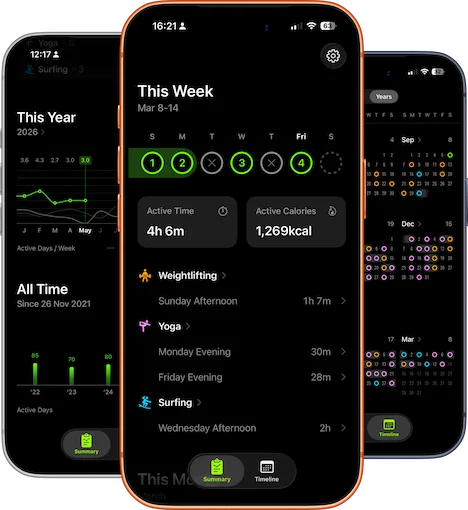
- For structured sets and external load: use Weightlifting.
- For bodyweight, free-weight, or mixed movement patterns: choose Strength Training.
- For focused trunk strength and control: use Core Training.
- For strength expressed through routes and holds: choose Climbing.
How To Judge Strength-Training Intensity
Heart rate can rise during circuits or large compound movements, but it does not directly describe the load on a muscle. Judge a set by the resistance, technique, speed, range of motion, and how many good repetitions you could still perform.
Rest long enough to make the next set match its purpose. Short rest can increase fatigue and make a session feel more cardiovascular; longer rest can support heavier or more explosive work. Neither is automatically better—the rest period should serve the training goal.
How Often Should You Strength Train?
For general health, the CDC recommends muscle-strengthening activity on at least two days per week, covering all major muscle groups. That is a population-level target rather than a fixed program.
Frequency depends on exercise selection, total volume, effort, experience, and recovery. Start with an amount you can repeat with stable technique, then add work gradually instead of making every set maximal.
Activity Types
The following Activity Types fall into the Strength category: