This resource is based on the "Everyone Is Wrong About Exercise" YouTube video by Bryan Johnson about five distinct dimensions of physical fitness: strength, aerobic fitness, high-intensity fitness, mobility, and balance.
The idea is simple: human health does not depend on a single physical capability. A person can be exceptionally strong while possessing poor cardiovascular fitness. An accomplished runner may neglect strength training. Many active people perform little dedicated mobility or balance work at all.
Johnson's framework addresses this by treating exercise as a collection of complementary systems rather than a competition between training styles. While the recommendations are not unique to Johnson, the framework provides a useful lens through which to evaluate a training routine.
Let's look at the 5 pillars.
Pillar 1: Strength Training
Strength Training forms the foundation of Johnson's framework. Muscle mass and strength support far more than athletic performance: skeletal muscle plays an important role in glucose regulation, metabolic health, joint stability, and functional independence.
Age-related loss of muscle mass, known as sarcopenia, is a major contributor to frailty later in life. Strength training helps counteract this decline. The goal is not necessarily to maximize muscle size or achieve elite performance, but to maintain sufficient strength for everyday function and preserve physical capacity with age.
Most longevity-focused strength programs emphasize compound movements that train large muscle groups simultaneously, including:
- Deadlifts and hinge movements
- Push-ups and presses
- Rows and pull-ups
- Squats and squat variations
Johnson recommends regular strength training throughout the week rather than concentrating exercise exclusively on cardiovascular activities.
Pillar 2: Aerobic Fitness and Zone 2 Training
The second pillar focuses on low-intensity aerobic exercise, often referred to as Zone 2 training (see Heart Rate Zones Explained).
Zone 2 is generally characterized by an effort that elevates heart rate while still allowing comfortable conversation. It is neither leisurely nor exhausting. Instead, it occupies the broad middle ground where sustained aerobic work becomes possible.
At this intensity, the body relies heavily on aerobic metabolism, producing adaptations that improve endurance and cardiovascular efficiency. Common Zone 2 activities include:
Johnson recommends accumulating approximately 150 minutes of aerobic exercise each week, which closely mirrors public health guidelines. One practical aspect of his approach is the emphasis on consistency. Aerobic fitness is generally built through regular exposure over time rather than occasional high-effort sessions.
Pillar 3: High-Intensity Training and VO₂ max
While aerobic training develops endurance, Johnson argues that a longevity-focused exercise program should also include dedicated high-intensity work. The primary physiological target is cardiorespiratory fitness, often measured through VO₂ max.
VO₂ max represents the maximum amount of oxygen the body can use during intense exercise. It reflects the combined performance of multiple systems:
- The heart's ability to pump blood
- The lungs' ability to exchange gases
- The muscles' ability to use oxygen
- The vascular system's ability to transport oxygen
Improving VO₂ max generally requires exercise intensities beyond those used during typical Zone 2 training. Common approaches include:
- Cycling intervals
- Hill repeats
- Rowing intervals
- Running intervals
- Structured interval protocols such as Norwegian 4x4 Interval Training
Low-intensity and high-intensity exercise produce different adaptations. Rather than viewing them as competing approaches, the framework treats them as complementary.
Pillar 4: Mobility Training
Mobility receives less attention than strength or cardiovascular fitness, partly because it is more difficult to quantify. Nevertheless, it influences how comfortably and efficiently people move through everyday life.
Mobility encompasses the ability to move joints through their intended range of motion while maintaining control and stability. Limitations can affect posture, movement quality, exercise technique, and overall comfort. As people age, joint range of motion often declines, particularly without regular movement.
Johnson therefore includes dedicated mobility work as a separate pillar rather than assuming it will emerge automatically from other forms of exercise. Areas commonly targeted include:
- Ankles
- Hips
- Shoulders
- Thoracic spine
Even relatively short daily sessions can help maintain movement quality over time.
Pillar 5: Balance Training
Among the five categories, balance is perhaps the least discussed in conventional fitness programming. Yet it becomes increasingly important with age.
Balance is not simply a property of the musculoskeletal system. It emerges from several systems working together:
- Neurological coordination
- Proprioceptive feedback from muscles and joints
- The vestibular system of the inner ear
- Vision
Johnson recommends incorporating simple balance exercises into a regular routine, including:
- Balance-focused movement practices
- Single-leg deadlifts
- Single-leg stands
- Stability drills
The objective is not athletic performance. It is to preserve coordination and reduce the likelihood of falls later in life.
A Portfolio Approach to Exercise
The most interesting aspect of Johnson's framework may not be any individual pillar. Strength training, aerobic exercise, interval training, mobility, and balance are all widely recognized as valuable components of physical health. What is more interesting is the way the framework treats exercise as a portfolio.
Many people naturally gravitate toward a single mode of training. Runners tend to run, lifters tend to lift, and cyclists tend to cycle. Over time, this specialization can create blind spots. The five-pillar model provides a simple way to identify those gaps.
A runner might discover that strength training occupies only a small fraction of their exercise regiment. A strength-focused athlete may realize that cardiovascular training is largely absent. Someone pursuing general health may find that mobility and balance have never become regular habits.
The framework encourages breadth rather than specialization.
How to Evaluate Your Exercise Routine Over Time
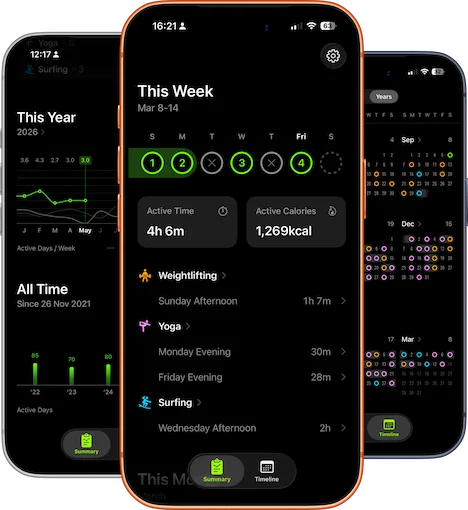
One challenge with any exercise framework is determining whether it actually describes your behavior. Most exercise recommendations are expressed in weekly, monthly, or yearly terms, yet many people evaluate their training based on their most recent workout.
This can be misleading. A single long run says little about aerobic consistency. One strength session does not reveal whether strength training has been maintained over the last six months. Similarly, a mobility session performed today tells us nothing about long-term adherence.
The relevant timescale for most health-related exercise outcomes is measured in months and years. Looking at workout history often reveals patterns that are difficult to recognize otherwise:
- Are mobility and balance work represented at all?
- Has aerobic training increased or declined?
- How frequently are you performing strength workouts?
- How has your routine changed over time?
- Which activity types dominate your training?
Viewed through this lens, Johnson's framework becomes less about individual workouts and more about the overall composition of your exercise routine.
What Are You Training to Keep?
The five pillars are most useful as a diagnostic, not a rigid prescription. You do not need to divide your training equally between them or squeeze all five into every week. The point is to notice what your routine develops reliably—and what it leaves untouched.
Workout history makes that assessment more honest. You may think of yourself as active while the record shows months dominated by one activity, with little strength, intensity, mobility, or balance work. That does not call for a complete overhaul. Start with the most neglected pillar, add the smallest practice you can repeat, and watch whether the shape of your training changes over time.
Training for longevity is ultimately about preserving options: the strength to carry, the endurance to keep going, the capacity to work hard, the mobility to move freely, and the balance to remain steady. Specialization may improve a particular score. Breadth helps keep more of life available to you.
So the better question is not, “Did I train hard today?” It is, “What is my routine helping me remain capable of doing decades from now?”